
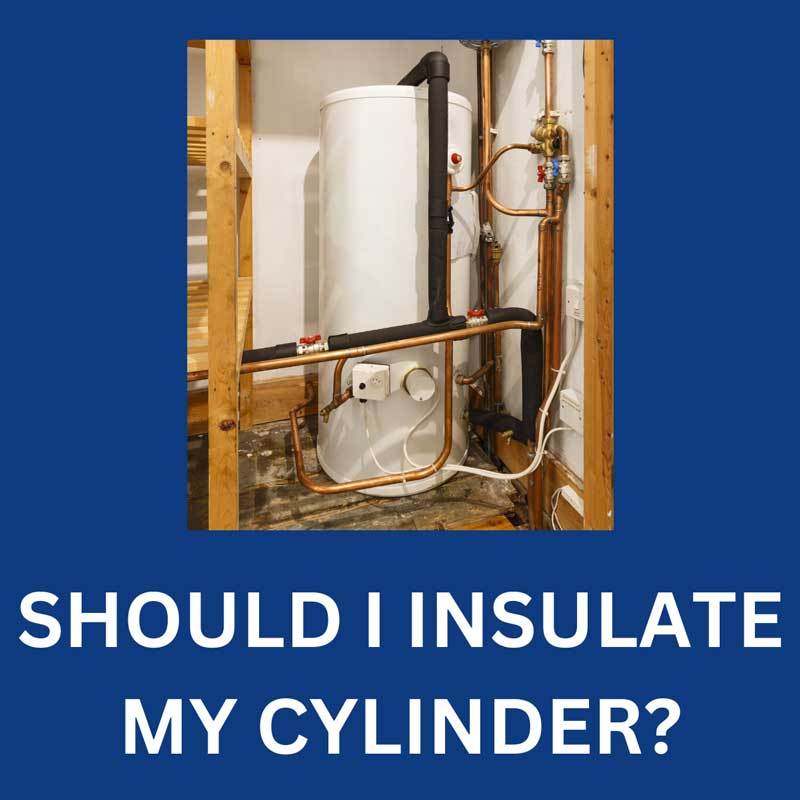
Hot water cylinders are a key component in central heating systems that utilise a ‘System’ or ‘Regular’ Boiler.
Insulation plays an important role in our heating systems’ efficiency, safety, and longevity.
One common question from our customers is, ‘Should I insulate my hot water cylinder?’
This article will answer this question.
What Is A Hot Water Cylinder?
A hot water cylinder, often nestled away in a cupboard, is a central heating system’s storage tank for hot water. Depending on the household demand, these cylinders hold and maintain hot water until needed for tasks like showering or washing dishes.
Types Of Hot Water Cylinders
There are two types of hot water cylinders
Vented
This traditional type of cylinder is connected to a cold water storage tank in the loft.
The tank feeds cold water to the cylinder, where it’s heated and drawn off when required.
Due to its reliance on gravity to push the water through, the system might have less water pressure than its unvented counterpart.
The vent pipe often ensures safety which releases excess pressure and steam.
Unvented
The unvented cylinder connects directly to the main water supply in a more modern and compact system.
It offers the benefit of better water pressure and eliminates the need for a cold water tank in the loft.
Safety measures in unvented systems are more intricate and include pressure relief valves and thermostats to prevent overheating.
Both types of cylinders store hot water efficiently. However, as with any system holding hot water, there’s an inevitable loss of heat over time, which brings us to the importance of insulation.
Why Insulation Is Important
There are several reasons why cylinder insulation is important.
Energy Efficiency & Reduced Heat Loss
A non-insulated cylinder continuously loses heat. The system must reheat the water more frequently to maintain the desired temperature. Insulation acts as a barrier, slowing down this heat loss and, in turn, reducing the energy required to keep the water hot.
Consistent Water Temperature
Nobody likes an unexpectedly cold shower. Insulated cylinders provide more consistent water temperatures, ensuring that the hot water you expect is precisely what you get.
Potential Cost Savings On Energy Bills
As the system operates more efficiently with reduced reheating intervals, homeowners save energy and can notice a marked reduction in energy bills. Over time, these savings can be substantial.
Enhanced Safety
An insulated cylinder is safer in a household setting, especially if children are present. Insulation minimises the risk of burns from accidentally touching the hot surface of the cylinder.
Environmental Benefits
With the world gravitating towards more sustainable living, every action counts. Using less energy translates to a reduced carbon footprint. By insulating your cylinder, you are saving money and playing a role in environmental conservation.
Prolonged Equipment Lifespan
Consistent reheating can wear down the components of a heating system faster. By reducing the frequency of reheating, the entire system undergoes less strain, which can lead to a longer operational life.
While the primary function of a hot water cylinder is straightforward, proper insulation is good for your wallet, safety, comfort, and the environment.
Do All Hot Water Cylinders Need Insulating?
Whether or not you should insulate your cylinder
Modern Cylinders
Many modern hot water cylinders come pre-insulated by the manufacturer. These are typically wrapped in foam or another insulating material directly bonded to the cylinder. If your cylinder has built-in insulation, adding additional insulation should not be necessary, as they are designed for optimal heat retention.
Older Cylinders
Older cylinders, especially those from several decades ago, often have little insulation. Modern cylinder insulation is around 80mm thick. If your cylinder has less than 80mm insulation or none, you should insulate it.
A Simple Test
Here’s a simple test you can undertake to determine if your hot water cylinder needs insulating.
If your hot water cylinder feels warm to the touch, it’s a clear sign that it’s losing heat and would benefit from insulation.
Insulate Your Hot Water Cylinder
Here’s a step-by-step guide on how to insulate your cylinder using an insulation jacket:
Materials & Tools Needed
- Cylinder insulation jacket or cylinder lagging of the appropriate size and recommended thickness (usually at least 80mm for modern standards).
- Tape measure.
- Scissors or utility knife (if trimming is required).
- Duct tape or similar (optional for securing edges).
Steps To Insulate Your Cylinder
- Measure the Cylinder: Use your tape measure to determine the height and diameter of your cylinder. This will help you choose the correct size of insulation jacket.
- Select the Right Insulation Jacket: Purchase an insulation jacket that fits your cylinder’s measurements. If in doubt, buy a larger size; you can always trim it to fit.
- Safety First: Before starting, ensure you’ve turned off any electrical connections related to the hot water cylinder, especially if it’s an immersion heater.
- Prepare the Cylinder: Ensure the cylinder’s surface is clean and dry. Remove any loose or old insulation materials if present.
- Position the Jacket: Begin by placing the jacket around the cylinder. Most jackets are split into two pieces – a larger piece for the body of the cylinder and a top cap. Start by wrapping the larger piece around the cylinder’s body.
- Secure the Jacket: Most modern insulation jackets come with straps or ties. Pull them tight and fasten them securely, ensuring there are no gaps. The jacket should fit snugly against the cylinder. If it’s too large, trim the excess with scissors or a utility knife and then secure.
- Insulate the Top: Place the top cap piece on the cylinder’s top, ensuring it fits snugly. Insulating the top is essential as heat rises; significant heat loss can occur from an uninsulated top.
- Check for Access Points: Ensure you still have access to any controls, valves, or other components you might need to reach. Make cuts in the insulation jacket if necessary to allow access.
- Secure Edges (Optional): If you find any edges that aren’t sitting snugly or have made cuts for access points, you can use duct tape or similar adhesive tape to secure them.
- Regular Maintenance: Over time, check the insulation jacket for wear, tear, or dampness. Replace or repair it as needed to ensure ongoing efficiency.

Hi, I’m Terry, the founder and owner of TM Hughes & Son Gas Services
Please get in touch to book an appointment or receive a free, no-obligation quote
Call – 01245 830075
Email – info@tmhughesandson.uk
0% Finance
For Boiler Installations & Repair